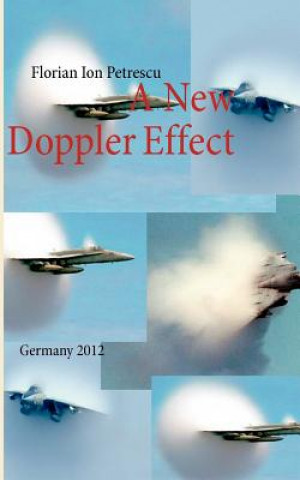
Kniha New Doppler Effect Florian Ion Petrescu

New Doppler Effect

Jazyk: Angličtina
Vazba: Brožovaná
Vydavatel: Books on Demand
Dostupnost: Skladem u dodavatele
Odesíláme za 5-8 dnů
176
The Doppler effect (or Doppler shift), named after Austrian physicist Christian Doppler who proposed...

Informace o knize

Jazyk
Angličtina
Vazba
Kniha - Brožovaná
Vydáno
2012
Stránek
82
EAN
9783848229901
ISBN
3848229900
Enbook ID
01839791
Vydavatel
Hmotnost
91
Rozměry
127 x 203 x 4

Kompletní popis

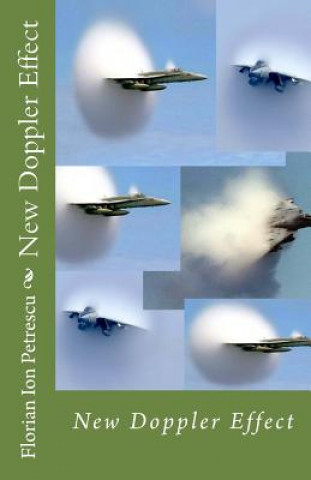
The Doppler effect (or Doppler shift), named after Austrian physicist Christian Doppler who proposed it in 1842 in Prague, is the change in frequency of a wave for an observer moving relative to the source of the wave. It is commonly heard when a vehicle sounding a siren or horn approaches, passes, and recedes from an observer. The received frequency is higher (compared to the emitted frequency) during the approach, it is identical at the instant of passing by, and it is lower during the recession.The relative changes in frequency can be explained as follows. When the source of the waves is moving toward the observer, each successive wave crest is emitted from a position closer to the observer than the previous wave. Therefore each wave takes slightly less time to reach the observer than the previous wave. Therefore the time between the arrival of successive wave crests at the observer is reduced, causing an increase in the frequency. While they are travelling, the distance between successive wave fronts is reduced; so the waves \"bunch together\". Conversely, if the source of waves is moving away from the observer, each wave is emitted from a position farther from the observer than the previous wave, so the arrival time between successive waves is increased, reducing the frequency. The distance between successive wave fronts is increased, so the waves "spread out".For waves that propagate in a medium, such as sound waves, the velocity of the observer and of the source is relative to the medium in which the waves are transmitted. The total Doppler Effect may therefore result from motion of the source, motion of the observer, or motion of the medium. Each of these effects is analyzed separately. For waves which do not require a medium, such as light or gravity in general relativity, only the relative difference in velocity between the observer and the source needs to be considered.

Mohlo by vás zajímat

1 488

Freud

Jonathan Lear
819
465
590

New Doppler Effect

Dr Florian Ion T Petrescu
149
327
287

Welcome Home

Lucia Berlin
371

Knit, Purl, Pray

Lisa Bogart
379

Manual for Marriage

Danielle Bean
508

Keyboards (Grade 6)

Trinity College London
627
1 109

Eccentric Symmetries

Nancy Springer
264

Parsing Theory

Seppo Sippu
1 120
1 147

Zákaznicí kteří koupili tuto knihu koupili také

Dein Herz stach mir ins Auge

Claudia Toucas-Wardenberg
299
645

Fahrzeuge

Maria Brzozowska
352
441
531
1 495

Wild, 1 Audio-CD

Michael Mittermeier
353
878

Jules Cesar

William Shakespeare
397