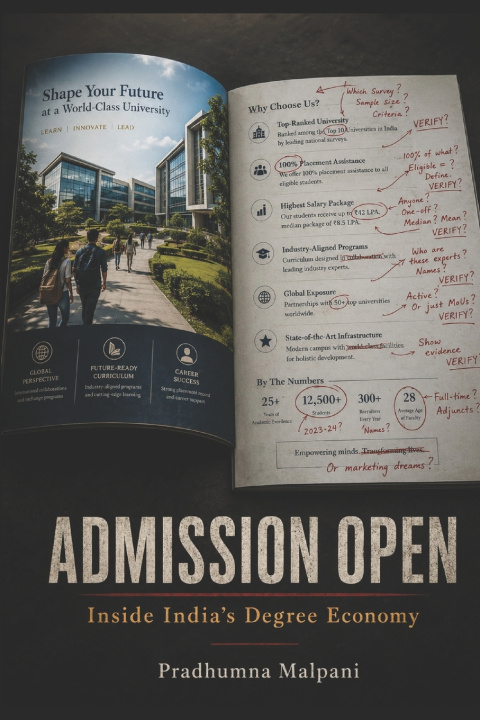
Someone is going to call your family this week. They will mention a scholarship deadline. They will say the seats are filling. They will quote an average CTC that sounds like a promise. They will not tell you it is the average, not the median. They will not tell you that the top recruiter on the placement report was incorporated fourteen months ago with ₹1 lakh paid-up capital and two directors.
They will not tell you that the NAAC inspector who graded this institution was arrested in February 2025 for demanding ₹1.80 crore in cash and gold. They will not tell you that the overseas consultant advising your family is simultaneously collecting 15% commission from the university he just recommended. They are not required to tell you any of this. They are counting on you not finding out.
Admission Open is what happens when someone who spent eight years inside more than 150 private universities across India decides to write down everything he saw.
Pradhumna Malpani - advocate at the High Court of Madhya Pradesh and former National Convenor of INDGenius, India's premier private university student network - has built a forensic investigation of India's degree economy from CBI charge sheets, Supreme Court judgments, NIRF filings, parliamentary records, and the kind of institutional candour that only happens when the doors are closed. The placement statistic is manufactured. The ranking is optimised. The accreditation is compromised. The overseas consultancy has a conflict of interest your family was never told about. The online degree's UGC recognition may have lapsed for the specific session you are enrolling in. The scholarship deadline will reset on Monday. Every single one of these claims is documented, sourced, and named.
But this book does not leave you with the problem. The final chapter is a complete verification toolkit - ten frameworks using only free government portals, no expert required - that tells you exactly how to check the placement data, audit the faculty, verify the NIRF ranking, expose ghost recruiters on the MCA portal, confirm online degree recognition on the UGC-DEB portal, and calculate whether the education loan your family is considering will be serviceable on the salary this credential actually produces. It includes the Consumer Protection Act 2019 remedies available to students who were misled. It ends with ten questions that any family can ask before signing the enrollment form. A quality institution answers all ten. An institution that deflects has already answered the only question that matters.
India's degree economy has spent two decades counting students and calling it education. 13,892 of them died by suicide in 2023 alone. ₹96,847 crore in education loans is outstanding. Millions of families have paid everything they had for a promise that the system was never designed to keep. This book will not change the system overnight. But it will change what happens in your family before the form is signed.
The brochure is still beautiful. This is the annotation.