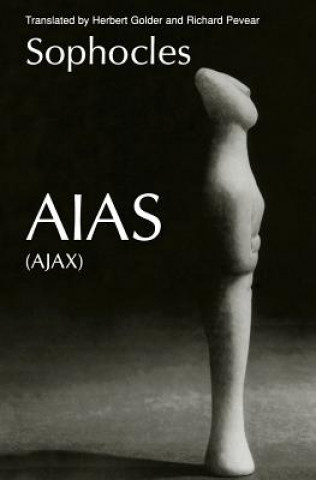
In this new translation, Sophocles early masterpiece comes boldly to life. In Greek tradition, Aias is the outmoded warrior whom time passes by. In Sophocles play, he becomes the man who moves resolutely beyond time. Most previous versions and interpretations have equivocated over Sophocles bold vision. This version attempts to translate precisely that transformation of the hero from the bygone figure to the man who stops time. In Homer, Aias is the immovable bulwark of the Achaians, second only to Achilles in battle prowess and size. But when Achilles dies, his armor is given to the wily Odysseus, not Aias. Shamed, and driven to madness, Aias dies a dishonorable death by suicide. He becomes, in death, the symbol of greatness lost; his death signals the end of a heroic age; in the visual arts, draped hideously over his huge sword, he becomes a momento mori. Sophocles plays upon his audiences expectation of all this. In the first scene Aias appears as the Homeric warrior turned mad butcher. It is harder to imagine a more degraded image of the hero.
But with each scene, Aias moves from darkness into greater and greater light, and speaks, contrary to the audiences expectations, more like a Heraclitean philosopher of the worlds flux than the laconic figure known from Homer. In fact, Sophocles Aias clearly sees his madness and the betrayal by the Greeks as merely symptomatic of a world in which nothing remains constant, not loyalties, not oaths, not friendship, not love. Not content to live in a world where nothing lasts, he resolves to live and therefore to die in accord with the more absolute law of his own inner nature. He thereby transforms his death into destiny, dying with his grip on the absolute rather than living on in a world of uncertainties. In death, he thus becomes the paradigm of permanence, of the human possibility of snatching the eternal from the desperately fleeting. This version embodies, and the introduction and notes hope to elucidate, how Sophocles brings this tragic vision of human greatness powerfully to life.