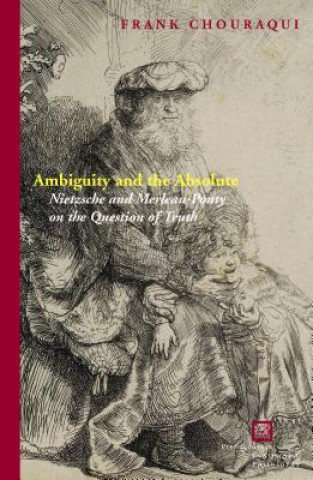
Kniha Ambiguity and the Absolute Frank Chouraqui

Ambiguity and the Absolute

Jazyk: Angličtina
Vazba: Pevná
Dostupnost: 50 % šance
Prohledáme celý svět
1 601
This book seeks to make a contribution to the history of modern philosophy by establishing a structu...
Informace o knize

Jazyk
Angličtina
Vazba
Kniha - Pevná
Vydáno
2013
Stránek
328
EAN
9780823254118
ISBN
0823254119
Enbook ID
02596812
Hmotnost
562
Rozměry
152 x 229 x 31

Kompletní popis

This book seeks to make a contribution to the history of modern philosophy by establishing a structural link between the thoughts of Friedrich Nietzsche and Maurice Merleau-Ponty. It is intended as a systematic exposition of both philosopher's key thoughts, as well as an inquiry on the origins of so-called continental philosophy. I argue that this link lies in the question of truth: although both thinkers criticize the traditional concept of truth as objectivity, they both find in the existence of this very concept a problem that its rejection alone does not solve. What is it in our natural existence that gave rise to the notion of truth? It is this questioning which I call the "question of truth." I locate three ways in which the question of truth informs Nietzsche and Merleau-Ponty's thoughts. Firstly, both thinkers propose a genealogy of the concept of "truth," one in which they suggest that our natural existence is structured in a pre-objective way: to exist means to make implicit truth claims. Further, they each explain the appearance of our belief in truth in terms of a radicalization of this implicit attribution of truth, which Nietzsche calls sublimation and Merleau-Ponty sedimentation. Secondly, both thinkers seek to recover the pre-objective ground from which truth as an erroneous concept arose. They propose strikingly similar methods to do so. This ground, once uncovered, must be examined. This investigation leads both Nietzsche and Merleau-Ponty to ontological considerations. They both ask how we must conceive of a Being whose structure allows for the existence of the belief in truth, or as I argue, error. As a conclusion, I suggest that both thinkers' investigations of the question of truth lead them to conceive of Being in a similar way, as the process of self-falsification by which indeterminate Being presents itself as determinate.

Mohlo by vás zajímat

666
245
706
1 972
299
1 950

Zákaznicí kteří koupili tuto knihu koupili také

309
690

Das Unbewusste

Mark Solms
1 361