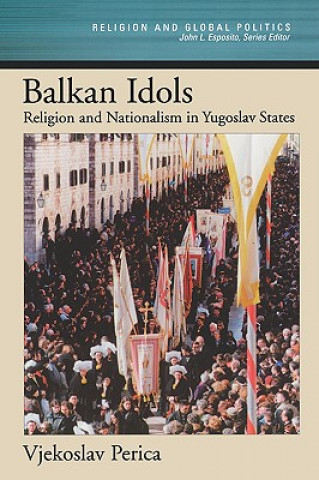
Kniha Balkan Idols Vjekoslav Perica

Balkan Idols

Jazyk: Angličtina
Vazba: Brožovaná
Dostupnost: Skladem u dodavatele
Odesíláme za 10-18 dnů
1 097
Reporting from the heartland of Yugoslavia in the 1970s, Washington Post correspondent Dusko Doder d...

Informace o knize

Jazyk
Angličtina
Vazba
Kniha - Brožovaná
Vydáno
2004
Stránek
362
EAN
9780195174298
ISBN
0195174291
Enbook ID
04476577
Hmotnost
554
Rozměry
154 x 228 x 22

Kompletní popis

Reporting from the heartland of Yugoslavia in the 1970s, Washington Post correspondent Dusko Doder described "a landscape of Gothic spires, Islamic mosques, and Byzantine domes." A quarter century later, this landscape lay in ruins. In addition to claiming tens of thousands of lives, the former Yugoslavia's four wars ravaged over a thousand religious buildings, many purposefully destroyed by Serbs, Albanians, and Croats alike, providing an apt architectural metaphor for the region's recent history. Rarely has the human impulse toward monocausality--the need for a single explanation--been in greater evidence than in Western attempts to make sense of the country's bloody dissolution. From Robert Kaplan's controversial Balkan Ghosts, which identified entrenched ethnic hatreds as the driving force behind Yugoslavia's demise to NATO's dogged pursuit and arrest of Slobodan Milosevic, the quest for easy answers has frequently served to obscure the Balkans' complex history. Perhaps most surprisingly, no book has focused explicitly on the role religion has played in the conflicts that continue to torment southeastern Europe. Based on a wide range of South Slav sources and previously unpublished, often confidential documents from communist state archives, as well as on the author's own on-the-ground experience, Balkan Idols explores the political role and 1nfluence of Serbian Orthodox, Croatian Catholic, and Yugoslav Muslim religious organizations over the course of the last century. Vjekoslav Perica emphatically rejects the notion that a "clash of civilizations" has played a central role in fomenting aggression. He finds no compelling evidence of an upsurge in religious fervor among the general population. Rather, he concludes, the primary religious players in the conflicts have been activist clergy. This activism, Perica argues, allowed the clergy to assume political power without the accountablity faced by democratically-elected officials. What emerges from Perica's account is a deeply nuanced understanding of the history and troubled future of one of Europes most volatile regions.

Mohlo by vás zajímat

553

Second Born

Lance Wilson
698
2 055
267

Handful of Dust

Evelyn Waugh
347
153
49

Quantum Dynamic Imaging

Andre D. Bandrauk
2 703

Clinical Medical Ethics

Laura Weiss Roberts
1 965

Scientific Elite

William T. Golden
4 690
1 574

Summer Holiday

Sarah M. Eden
315
1 445

Zákaznicí kteří koupili tuto knihu koupili také

426
51

Zagor. Samurai

Guido Nolitta
748

Sün Balázs

Csukás István
150

Allgemeine Mythologie

Friedrich Kurts
645

Briefe aus Berlin

Heinrich Heine
690
457

Objektbezogene Legalplanung.

Christian Schneller
1 749