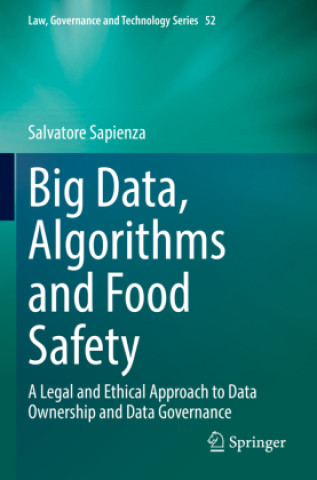
Kniha Big Data, Algorithms and Food Safety Salvatore Sapienza

Big Data, Algorithms and Food Safety

A Legal and Ethical Approach to Data Ownership and Data Governance

Jazyk: Angličtina
Vazba: Brožovaná
Vydavatel: Springer, Berlin
Dostupnost: Skladem u dodavatele
Odesíláme za 5-8 dnů
2 286
This book identifies the principles that should be applied when processing Big Data in the context o...


Informace o knize

Jazyk
Angličtina
Vazba
Kniha - Brožovaná
Vydáno
2023
Stránek
216
EAN
9783031093692
Enbook ID
44314019
Vydavatel
Hmotnost
331
Rozměry
155 x 235

Kompletní popis

This book identifies the principles that should be applied when processing Big Data in the context of food safety risk assessments. Food safety is a critical goal in the protection of individuals' right to health and the flourishing of the food and feed market. Big Data is fostering new applications capable of enhancing the accuracy of food safety risk assessments. An extraordinary amount of information is analysed to detect the existence or predict the likelihood of future risks, also by means of machine learning algorithms. Big Data and novel analysis techniques are topics of growing interest for food safety agencies, including the European Food Safety Authority (EFSA). This wealth of information brings with it both opportunities and risks concerning the extraction of meaningful inferences from data. However, conflicting interests and tensions among the parties involved are hindering efforts to find shared methods for steering the processing of Big Data in a sound, transparent and trustworthy way. While consumers call for more transparency, food business operators tend to be reluctant to share informational assets. This has resulted in a considerable lack of trust in the EU food safety system. A recent legislative reform, supported by new legal cases, aims to restore confidence in the risk analysis system by reshaping the meaning of data ownership in this domain. While this regulatory approach is being established, breakthrough analytics techniques are encouraging thinking about the next steps in managing food safety data in the age of machine learning.The book focuses on two core topics - data ownership and data governance - by evaluating how the regulatory framework addresses the challenges raised by Big Data and its analysis in an applied, significant, and overlooked domain. To do so, it adopts an interdisciplinary approach that considers both the technological advances and the policy tools adopted in the European Union, while also assuming an ethical perspective when exploring potential solutions. The conclusion puts forward a proposal: an ethical blueprint for identifying the principles - Security, Accountability, Fairness, Explainability, Transparency and Privacy - to be observed when processing Big Data for food safety purposes, including by means of machine learning. Possible implementations are then discussed, also in connection with two recent legislative proposals, namely the Data Governance Act and the Artificial Intelligence Act.

Mohlo by vás zajímat

Where Are My Pets?

Michele Wilson
522

The Monks Make Amends

Christopher Tupa
308
149

Flowers for Mrs. Luskin

Arthur Jay Harris
390
537
2 337

Tangofulness

Bronowski Dimitris Bronowski
427
411
397
1 471

Zákaznicí kteří koupili tuto knihu koupili také

GmbH-Recht

Harald Bartl
3 525

Samochody

Zakrzewski Bartosz
221

Amulettmagier

Natascha Honegger
532
129

Židovská Praha

Hana Maciuchová
112

A Quinta Dimens?o: Volume 4

Emanuel Dimas De Melo Pimenta
376
1 064
557
275
1 641