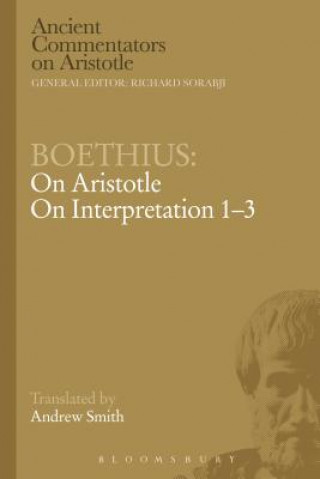
Kniha Boethius: On Aristotle On Interpretation 1-3 Boethius

Boethius: On Aristotle On Interpretation 1-3

Autor: Boethius
Jazyk: Angličtina
Vazba: Pevná
Dostupnost: Skladem u dodavatele
Odesíláme za 10-18 dnů
4 426
Boethius (c. 480-c. 525) wrote his highly influential second commentary on Aristotle's On Interpreta...


Informace o knize

Autor
Jazyk
Angličtina
Vazba
Kniha - Pevná
Vydáno
2010
Stránek
176
EAN
9780715639184
ISBN
0715639188
Enbook ID
04437295
Hmotnost
436
Rozměry
162 x 241 x 20

Kompletní popis

Boethius (c. 480-c. 525) wrote his highly influential second commentary on Aristotle's On Interpretationin Latin, but using the style of the Greek commentaries on Aristotle. It was part of his project to bring knowledge of Plato and Aristotle to the Latin-speaking world of his fellow Christians. The project was cruelly interrupted by his execution at the age of about 45, leaving the Latin world under-informed about Greek Philosophy for 700 years. Boethius reveals to us how On Interpretation was understood not only by himself, but also by some of the best Greek interpreters, especially Alexander and Porphyry. Alexander had insisted that its subject was composite thoughts, not composite sentences nor composite things - it is thoughts that are primarily true or false. Although Aristotle's first six chapters define name, verb, sentence, statement, affirmation and negation, Porphyry had claimed that Aristotelians believe in three types of name and verb, written, spoken and mental, in other words a language of the mind. Boethius discusses individuality and ascribes to Aristotle a view that each individual is distinguished by having a composite quality that is not merely unshared, but unshareable. Boethius also discusses why we can still say that the dead Homer is a poet, despite having forbidden us to say that the dead Socrates is either sick or well. But Boethius' most famous contribution is his interpretation of Aristotle's discussion of the threat of that tomorrow's events, for example a sea battle, will have been irrevocable 10,000 years ago, if it was true 10,000 years ago that there would be a sea battle on that day. In Boethius' later "Consolation of Philosophy", written in prison awaiting execution, he offered a seminal conception of eternity to solve the related problem of future events being irrevocable because of God's foreknowledge of them.

Mohlo by vás zajímat

Outlander

Gil Adamson
214

Luscious

Alison Tyler
343

123 VAVAVROOM

Sarah Lynn
308

Russia and the Russians

Geoffrey Hosking
910
658

Nemesis Syndrome

Walt Branam
476
880

Crooked Kingdom

Leigh Bardugo
200
600
351

Rainbow Dreaming-A Big Book of Calm

Amy (Flinders University of South Australia) Hamilton
323

Angels

Clarke
311
220

The Land and the Cross

Valentina Burgassi
4 473

Gambara

Honore De Balzac
250

Etsy for Beginners

The Passive Income Strategist
370

Why Do I Keep Doing This!!?

Pearson Judith E Pearson
75

Zákaznicí kteří koupili tuto knihu koupili také

Štvanice

Antonín Thurnwald
107
1 736
335

Sermons - tome 2

Léon le Grand
810
79

Prisma Evaluación (A1/A2) Audio CDs (2) + 1 CD PDFs

Noelia González Verdejo y Jan Peter Nauta
1 114

TODAVÍA HAY PRIMAVERA. TODAVÍA

JOAQUIN ANTONIO PEÑALOSA
501

Schul-Spuren

Stefan Rogal
947

Dobra Púrpura

Walter Sasso
180

Hemisféry

Kamil Bouška
121
1 437