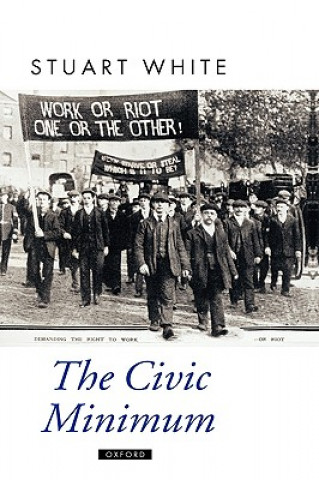
Kniha Civic Minimum Stuart White

Civic Minimum

On the Rights and Obligations of Economic Citizenship

Autor: Stuart White
Jazyk: Angličtina
Vazba: Pevná
Dostupnost: Skladem u dodavatele
Odesíláme za 10-18 dnů
3 084
Many governments today are engaged in far-reaching programs of 'welfare reform'. But what would a ju...


Informace o knize

Autor
Jazyk
Angličtina
Vazba
Kniha - Pevná
Vydáno
2003
Stránek
300
EAN
9780198295051
ISBN
0198295057
Enbook ID
04525259
Hmotnost
572
Rozměry
166 x 243 x 23

Kompletní popis

Many governments today are engaged in far-reaching programs of 'welfare reform'. But what would a just program of welfare reform consist in? Is the current emphasis on linking welfare 'rights' to 'responsibilities' justifiable? In this book, Stuart White reconsiders the principles of economic citizenship appropriate to a democratic society, and explores the radical implications of these principles for public policy. According to White, justice demands that economic cooperation satisfy a standard of 'fair reciprocity'. Against a background of institutions that are sufficiently just in other respects, those citizens who share in the social product have an obligation to make a productive contribution back to the community in return: every citizen should 'do her bit'. While prominent in the work of many past egalitarian thinkers, this duty to contribute has not received much attention in recent political theory. White seeks to redress this neglect, and to show why and how the claims of reciprocity should be integrated with other important concerns that have featured more prominently in recent literature. These include the concerns to prevent brute luck disadvantage and economic vulnerability. From the standpoint of fair reciprocity, it is not necessarily unjust to link welfare rights with the performance of work-related responsibilities. But the justice of such a linkage depends on how far economic institutions meet other requirements of justice. In policy terms, fair reciprocity thus calls for a generous 'civic minimum' in which work-related welfare benefits are complemented by other policies designed to prevent poverty and vulnerability, secure opportunity for meaningful work, and eliminate class-based inequalities in educational opportunity and inherited wealth. In concluding, White contests the fashionable view that egalitarian reform is unfeasible in contemporary circumstances. The philosophy of fair reciprocity provides the basis for a new public conversation about economic citizenship, in which all citizens - not just those currently amongst the welfare poor - are encouraged to confront their responsibility to others.

Mohlo by vás zajímat

Patrick Modiano

Alan Morris
3 852
375

HORSES RESCUE

Gerard Doan
564

Goblin Emperor

Katherine Addison
241
6 170
600
1 642
167

Planet Obesity

Garry Egger
347

Management 3.0

Jurgen Appelo
1 067
13 102

Zákaznicí kteří koupili tuto knihu koupili také

359
142