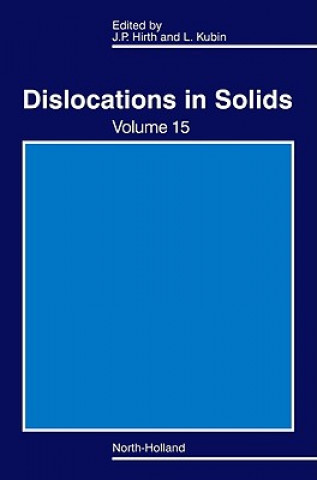
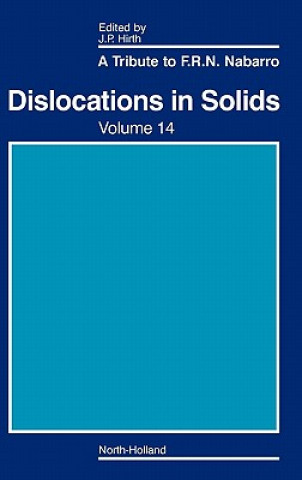
Kniha Dislocations in Solids F. Nabarro

Dislocations in Solids

Jazyk: Angličtina
Vazba: Pevná
Dostupnost: U nakladatele na objednávku
Odesíláme za 28-34 dnů
6 889
This is the first volume to appear under the joint editorship of J.P. Hirth and F.R.N. Nabarro. Whil...

Informace o knize

Jazyk
Angličtina
Vazba
Kniha - Pevná
Vydáno
2004
Stránek
602
EAN
9780444514837
ISBN
044451483X
Enbook ID
04611209
Hmotnost
1220
Rozměry
165 x 240

Kompletní popis

This is the first volume to appear under the joint editorship of J.P. Hirth and F.R.N. Nabarro. While Volume 11 concentrated on the single topic of dislocations and work hardening, the present volume spreads over the whole range of the study of dislocations from the application by Kl man and his colleagues of homotopy theory to classifying the line and point defects of mesomorphic phases to Chaudhri's account of the experimental observations of dislocations formed around indentations. Chapter 64, by Cai, Bulatove, Chang, Li and Yip, discusses the influence of the structure of the core of a dislocation on its mobility. The power of modern computation allows this topic to be treated from the first principles of electron theory, and with empirical potentials for more complicated problems. Advances in electron microscopy allow these theoretical predictions to be tested. In Chapter 65, Xu analyzes the emission of dislocations from the tip of a crack and its influence on the brittle to ductile transition. Again, the treatment is predominantly theoretical, but it is consistently related to the very practical example of alpha iron. In a dazzling interplay of experiment and abstract mathematics, Kl man, Lavrentovich and Nastishin analyze the line and point structural defects of the many mesomorphic phases which have become known in recent years. Chapter 67, by Coupeau, Girard and Rabier, is essentially experimental. It shows how the various modern techniques of scanning probe microscopy can be used to study dislocations and their interaction with the free surface. Chapter 68, by Mitchell and Heuer, considers the complex dislocations that can form in ceramic crystals on the basis of observations by transmission electron microscopy and presents mechanistic models for the motion of the dislocations in various temperature regimes. While the underlying aim of the study of dislocations in energetic crystals by Armstrong and Elban in Chapter 69 is to understand the role of dislocations in the process of detonation, it has the wider interest of studying dislocations in molecular crystals which are "elastically soft, plastically hard, and brittle". Chaudhri in Chapter 70 discusses the role of dislocations in indentation processes, largely on the basis of the elastic analysis by E.H. Yoffe. The special case of nanoindentations is treated only briefly.

Mohlo by vás zajímat

6 477

Third Eye of Leah Leeds

Christopher Carrolli
369

Shepherd

Ethan Cross
470

Discrete Password Logbook

Suzeteo Enterprises
422

Walking in the Light

REBECCA FETZER
238

Natural Enemies

Roan Parrish
310

The Frontiersmen

Gustave Aimard
180
190
301

Saving Jimmy

James Johnson
581

What Might Have Been Expected

Frank Richard Stockton
259
506

Dream Catcher

DALE KISER
476

Hysterical Laughter

David Christenson
547
6 477
423

Purity

J M a Quinn
733

Zákaznicí kteří koupili tuto knihu koupili také

Geórgicas

Virgilio
289