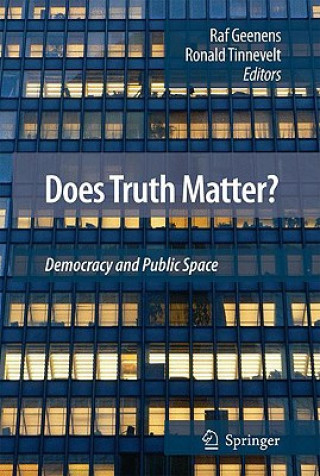
The claim once made by philosophers of unique knowledge of the essence of humanity and society has fallen into disrepute. Neither Platonic forms, divine revelation nor metaphysical truth can serve as the ground for legitimating social and political norms. On the political level many seem to agree that democracy doesn t need foundations. Nor are its citizens expected to discuss the worth of their comprehensive conceptions of the good life. According to Rawls, for example, we have to accept that politics in a democratic society can never be guided by what we see as the whole truth ( ) . (1993: 243) And yet we still call upon truth when we participate in defining the basic structure our society and argue why our opinions, beliefs and preferences need to be taken seriously. We do not think that our views need to be taken into account by others because they are our views, but because we think they are true. If in a democratic society citizens have to deal with the challenge of affirming their claims as true, we need to analyse the precise relationship between truth and democracy. Does truth matter to democracy and if so, what is the place of truth in democratic politics? How can citizens affirm the truth of their claims and accept - at the same time - that their truth is just one amongst many? Our book centers on the role of the public sphere in these pressing questions. It tries to give a comprehensive answer to these questions from the perspective of the main approaches of contemporary democratic theory: deliberative democracy, political pragmatism and liberalism. A confrontation of these approaches, will result in a more encompassing philosophical understanding of our plural democracy, which in this era of globalization is more complex than ever before.§Because a good understanding of the function, meaning and shortcomings of the public sphere is essential to answering these questions, a good deal of the book addresses these issues. Historically, after all, the idea that citizens have to engage each other in discussion in order to determine the structure and goals of society, is connected to the rational ideal of a public sphere where conflicting views can be expressed, formed, and transformed. But hasn t the collective decision making in which everyone participates on an equal footing turned out to be a deceptive ideal or a simple illusion? Not every individual in society has equal access to the podium. Furthermore, power, being an inevitable feature of the public sphere, seems to permanently endanger its democratic value. Moreover, the existence of this sphere depends on a specific ethos and particular public spaces where citizens are called upon to present themselves as citizens, as people taking responsibility for their society. It is not clear whether this ethos and these spaces exist at all, and if so, if they preserved their ascribed capacity for constituting democratic truth? By answering these questions we expect to deepen our understanding of the relation between truth and democracy.