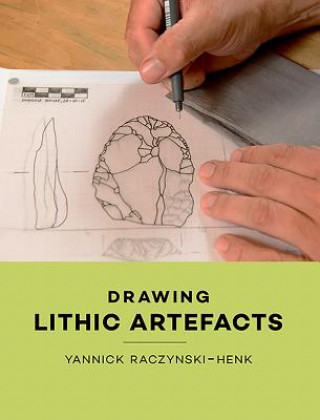
Kniha Drawing Lithic Artefacts Yannick Raczynski-Henk

Drawing Lithic Artefacts

Jazyk: Angličtina
Vazba: Brožovaná
Vydavatel: Sidestone Press
Dostupnost: Skladem u dodavatele
Odesíláme za 8-11 dnů
476
Stone Age researchers spend a lot of time studying and documenting lithic artefacts. Since it is imp...
Informace o knize

Jazyk
Angličtina
Vazba
Kniha - Brožovaná
Vydáno
2017
Stránek
52
EAN
9789088905308
ISBN
9088905304
Enbook ID
17973175
Vydavatel
Hmotnost
178
Rozměry
260 x 200 x 10

Kompletní popis

Stone Age researchers spend a lot of time studying and documenting lithic artefacts. Since it is impossible to study all these artefacts physically, they often rely on images. Drawings are often the most informative because the lines and symbols in these drawing contain technological information which tells the audience how the artefact depicted was made. Conversely, making these drawings is an excellent way of learning to recognise and understand this technological information. In a distant past Yannick aspired a career as an artist and while the art world is probably better off without him, he managed to find a new purpose for his artistic bend in his career as an archaeologist in the form of making lithic illustrations. Both professional and amateur archaeologists ask him questions about the drawings regularly with "It's probably very difficult, I'm sure?" the most prominent. Drawing lithic illustrations is bound to rules and conventions anybody can learn. Of course it helps if you have a deft hand at drawing, but this style of drawing is a craft, not an art form. A craft anybody can learn with a little perseverance. Starting from there, Yannick gives courses in drawing artefacts. While preparing these courses he noticed that almost no books or papers suitable as course material are available, a realisation eventually resulting in this book. Contents 1 Introduction 1.1 Art or craft 1.2 Why draw in the digital age 1.3 Reading guide 2 Conventions 2.1 Introduction 2.2 Terminology 2.3 Angle of incidence 2.4 Projections 2.5 French or American projection 2.6 Lines 2.7 Ripples 2.8 The ventral surface 2.9 Burins 2.10 Polished artefacts 2.11 Natural phenomena and damage 2.12 Burnt flint 2.13 Other symbols 2.14 Microliths 3 Preperations 3.1 Introduction 3.2 Residue and use-wear analysis 3.3 Digital illustration 3.4 Supply list 3.5 Function of the assorted supplies 3.6 The work station 3.7 The artefact 4 The pencil drawing 4.1 Introduction 4.2 Preparing the graph paper 4.3 The outline 4.4 The dorsal ridges 4.5 The dorsal negatives 4.6 The ventral surface and the bulb of percussion 4.7 The lateral sides 4.8 The cross-section 4.9 The striking platform and additional details 4.10 Refits 4.11 Finishing touches 5 The pen drawing 5.1 Preparations 5.2 The lay-out 5.3 Tracing the illustration 5.4 Finishing touches 6 Scanning and digitally editing your illustrations for publication 6.1 Scanning 6.2 Editing your illustration 6.3 Step one: paint it black 6.4 Step two: Increasing the contrast 6.5 Step three: making the illustration binary 6.6 Cosmetic alterations 7 Conclusion

Mohlo by vás zajímat

Doggerland

Sasja van der Vaart-Verschoof
888
1 181

Engraved Gems

B. J. L. van den Bercken
986

Gerulata: The Lamps

Robert Frecer
460
309

Practicing Stoic

Ward Farnsworth
509

Hate Notes

Vi Keeland
228
1 310

Remember When

T Torrest
431
932

Long Shot

Kennedy Ryan
220
433
386
307

Zákaznicí kteří koupili tuto knihu koupili také

Palaeolithic Italy

Valentina Borgia
1 476

Neanderthal Legacy

Paul A. Mellars
986
684

Pojazdy. Wycinam i sklejam

Opracowanie zbiorowe
76

Som idealista: Diár 2026

Iveta Tomášková
209

Gdy leżę, konając

William Faulkner
298

Tatort Stadt

Julika Griem
1 037
278

Habibi

Baja Dolce
332

Starik i more. Zelenye kholmy Afriki

Эрнест Хемингуэй
269
555

Porn ? What porn ?

Hope Tiefenbrunner
394

Tesař

Jon Gordon
98