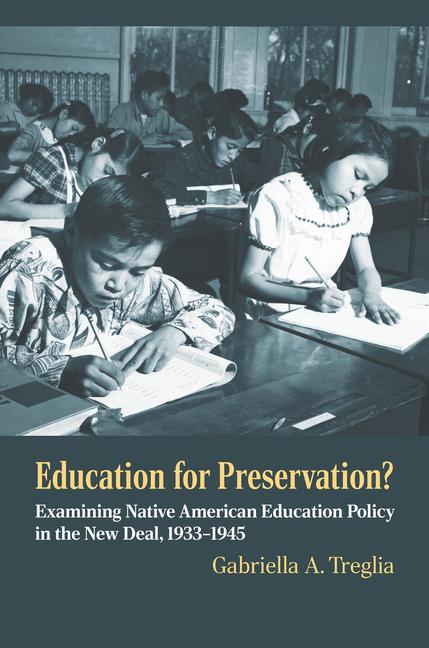
A groundbreaking new examination of federal Indian boarding schools in the New Deal era and the threats it posed to Indigenous sovereignty, from the old danger of assimilation to the new challenges of biculturalism and pluralism.
The destructive legacy of federal Indian boarding schools is undisputed. The education programs of the late nineteenth and early twentieth centuries engaged in a policy of cultural genocide designed to erase Indigenous cultures and identities, disrupt community and familial systems of cultural transmission, and impose a monocultural education throughout settler society. In the early 1930s, the Lakota author and educator Luther Standing Bear, himself a survivor of Carlisle Indian Boarding School, challenged the government to adopt a bicultural model of education. His call for reform coincided with a short-lived change in federal policy toward Native Americans that appeared to embrace this vision of this “double education,” a policy known as the “Indian New Deal” (1933–1945).
The Indian New Deal was a controversial series of reforms implemented by the Bureau of Indian Affairs (BIA) under the commissionership of John Collier. A reaction against the previous policy of coercive assimilation to US social, cultural, and economic norms, the Indian New Deal marked a shift to a pro-reservation, ostensibly pro-communitarian approach to “Indian Affairs.” Collier was idealistic but also highly paternalistic, and has been criticized both for holding romanticized, inaccurate views of Indigenous cultures and for continuing assimilation efforts with some policies.
Education for Preservation? examines the extent to which the New Deal reflected Standing Bear’s call for a bicultural approach to teaching, focusing on what was taught at the government day and boarding schools, and on the staff, pupil, and community experiences of the schools. Gabriella A. Treglia argues that the New Deal version of pluralism, rather than constituting a veiled extension of earlier assimilationist control—as some have argued—posed a new threat to Indigenous cultural sovereignty. Assimilationist in some areas and pluralist in others, and reflecting the underlying Eurocentric outlook of its creators, the “Indian New Deal” was fatally flawed.
Treglia’s groundbreaking work demonstrates the dangers of top-down education approaches that can, whether intentionally or inadvertently, perpetuate colonial education paradigms and settler colonialist narratives as well as generate cultural conflict.