A volume in Evaluation and Society
Series Editors, Jennifer C. Greene, University of Illinois at Urbana-Champaign
and Stewart I. Donaldson, Claremont Graduate University
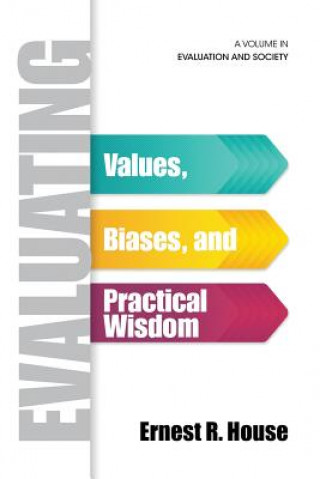
In this book, Ernie House reframes how we think about evaluation by reconsidering three key
concepts of values, biases, and practical wisdom. The first part of the book reconstructs core
evaluation concepts, with a focus on the origins of our values and biases. The second part
explores how we handle values and biases in practice, and the third shows how we learn practical
wisdom and use it in evaluations.
Value is the central concept in this volume, yet it's a fuzzy concept. In Part I, Ernie clarifies the
concept of value by addressing basic questions: What are values? Where do they come from?
Why do we have them? Why is our conception so confused? How do we handle values in evaluations?
In Part II, another central concept is added, that of biases. Prominent evaluation frameworks
have focused on biases, including Campbell and Stanley's (1963) framework for validating
causal inferences and Scriven's (1972) conception of objectivity, which is achieved by correcting for biases in general. In addition,
research on thought processes has made progress by focusing on cognitive biases (Kahneman, 2011). Even so, through a case example,
Ernie demonstrates that the concept of biases is under-appreciated and not well engaged in evaluation practice.
The third important concept, featured in Part III, is practical wisdom, which is the knowledge that evaluators acquire through experience.
Practical wisdom informs what we do, possibly as much as theory. Experienced evaluators often conduct evaluations in similar
ways, regardless of their theory, because practical wisdom determines much of what they do. Ernie provides concrete examples of practical
wisdom and how we employ it. Throughout the book, he draws on the empirical research on thinking processes, especially Kahneman's
Thinking Fast and Slow (2011).
This book will be of interest and relevance to all evaluation scholars and practitioners, as it thoughtfully engages core constructs of the
field. The book can also well serve as a supplementary text in multiple evaluation courses,
as it offers valuable conceptual and practical perspectives on our craft.