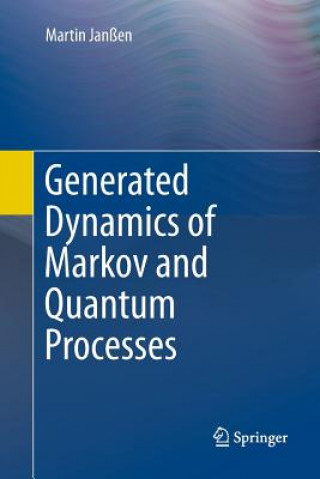
Kniha Generated Dynamics of Markov and Quantum Processes MARTIN JAN EN

Generated Dynamics of Markov and Quantum Processes

Autor: MARTIN JAN EN
Jazyk: Angličtina
Vazba: Brožovaná
Dostupnost: Skladem u dodavatele
Odesíláme za 5-8 dnů
1 120
This book presents Markov and quantum processes as two sides of a coin called generated stochastic p...
Informace o knize

Jazyk
Angličtina
Vazba
Kniha - Brožovaná
Vydáno
2018
Stránek
226
EAN
9783662570289
ISBN
9783662570289
Enbook ID
19684838
Hmotnost
3752
Rozměry
155 x 235 x 14

Kompletní popis

This book presents Markov and quantum processes as two sides of a coin called generated stochastic processes. It deals with quantum processes as reversible stochastic processes generated by one-step unitary operators, while Markov processes are irreversible stochastic processes generated by one-step stochastic operators. The characteristic feature of quantum processes are oscillations, interference, lots of stationary states in bounded systems and possible asymptotic stationary scattering states in open systems, while the characteristic feature of Markov processes are relaxations to a single stationary state. Quantum processes apply to systems where all variables, that control reversibility, are taken as relevant variables, while Markov processes emerge when some of those variables cannot be followed and are thus irrelevant for the dynamic description. Their absence renders the dynamic irreversible. A further aim is to demonstrate that almost any subdiscipline of theoretical physics can conceptually be put into the context of generated stochastic processes. Classical mechanics and classical field theory are deterministic processes which emerge when fluctuations in relevant variables are negligible. Quantum mechanics and quantum field theory consider genuine quantum processes. Equilibrium and non-equilibrium statistics apply to the regime where relaxing Markov processes emerge from quantum processes by omission of a large number of uncontrollable variables. Systems with many variables often self-organize in such a way that only a few slow variables can serve as relevant variables. Symmetries and topological classes are essential in identifying such relevant variables. The third aim of this book is to provide conceptually general methods of solutions which can serve as starting points to find relevant variables as to apply best-practice approximation methods. Such methods are available through generating functionals. The potential reader is a graduate student who has heard already a course in quantum theory and equilibrium statistical physics including the mathematics of spectral analysis (eigenvalues, eigenvectors, Fourier and Laplace transformation). The reader should be open for a unifying look on several topics.

Mohlo by vás zajímat

1 147

How to Become an Angel for Turtles

Longley Arthur Andrew Longley
699
190

Escapade

Charles Owen
190
316
5 098

Rome

Francis Wey
789

E-Mail Security

Paul S. Dowland
371

Black and Free

Tom Skinner
792

Convex Functions and their Applications

Lars-Erick (Lulea University of Technology) Persson
2 130
7 210

Marco Made Easy

Marco Pierre White
474

Knowing What To Do

Timothy Chappell
2 959

Zákaznicí kteří koupili tuto knihu koupili také

366
922

Fem el pessebre

EVA SANTANA
198
395

Caracterizacion de la Cultura Organizacional

Norbelis Del Valle Lacle Romero
789
214