Why do people flood into churches and temples during disasters - and disappear two weeks later?
This question opens one of the most honest investigations into human nature ever attempted in a single book.
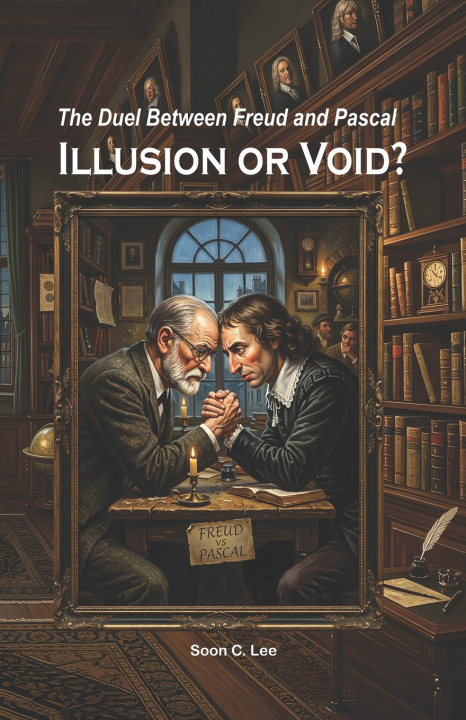
Sigmund Freud spent his life arguing that God is an illusion - a wish dressed up as reality, a father figure conjured by our deepest fears. Blaise Pascal spent his life arguing the opposite: that the emptiness inside every human being is not a malfunction but a sign, pointing toward something that nothing in this world can fill.
Two of the most serious minds in history. The same question. Opposite answers. One of them was wrong.
Illusion or Void? The Duel Between Freud and Pascal is the investigation.
Beginning with the universal human impulse to lean on something - religion, science, money, ideology, or a YouTube channel - this book traces the full landscape of what human beings reach for, and why nothing they reach for ever fully satisfies.
The journey moves through the great religious traditions of the world: Buddhism, Islam, Hinduism, Confucianism, shamanism, and the prosperity gospel. It examines why every tradition promises to fill the deepest human longing - and why none of them quite does. It looks honestly at what happened when the twentieth century tried to remove God entirely: the Soviet experiment, Mao's Cultural Revolution, North Korea's deification of its leader, Cuba's revolutionary martyrs. Remove God, the evidence suggests, and human beings do not stop worshipping. They simply find something else to worship - and the results have been catastrophic.
The book moves through the philosophers who tried to answer the question without religion: Socrates, Plato, Aristotle, Confucius, the Buddha, Voltaire, Kant, Nietzsche, Sartre, Marx. Each of them found something real. None of them found an answer that fully addressed the five deepest human longings: meaning, genuine connection, forgiveness, a new beginning, and something beyond death.
And then the book turns - carefully, honestly, without coercion - toward a figure from two thousand years ago who made claims so extraordinary they cannot be safely ignored. Who refused political power in the wilderness. Who refused to manufacture compelling spectacle. Who touched lepers, ate with traitors, forgave a dying criminal, and wept at a grave. Who said things that left no comfortable middle ground: I am the way. Before Abraham was, I am. Come to me, all you who are weary.
The book examines the evidence for the resurrection - not as a matter of religious belief, but as a historical question. It looks at what transformed a group of frightened people in hiding into people willing to die for what they said they had seen. It examines the structural difference between religion - which is always a transaction - and what this figure brought, which was a covenant.
And it ends not with a conclusion forced upon the reader, but with an open door.
Illusion or Void? is written for the person who is not religious - and yet finds themselves unable to fully dismiss the question. For the person who has tried the secular answers and found them insufficient. For the person who wakes at three in the morning and stares at the ceiling and feels something missing that they cannot name.
It is written, in the end, for anyone who is weary.
The investigation is serious. The evidence is examined honestly. The door, at the end, is open.
Whether you walk through it is entirely yours to decide.
Soon C. Lee is a Korean-born thinker and author of twelve books. He lives in Downey, California.