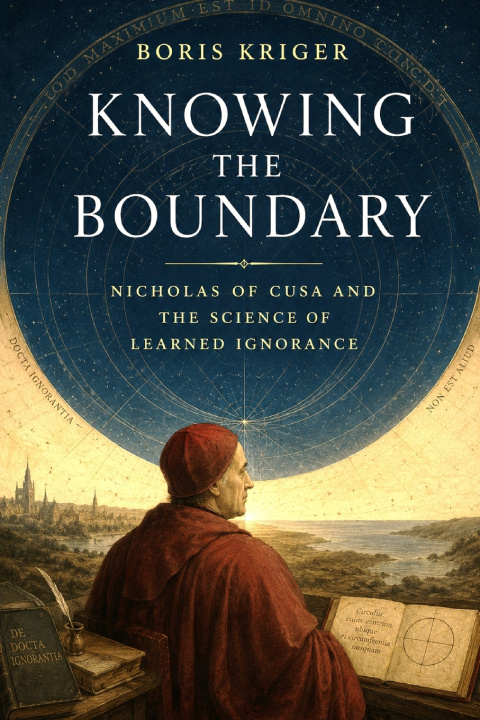
In the winter of 1437, on a ship crawling home from Constantinople, a German churchman was struck by an idea so strange that he spent the rest of his life defending it: the highest form of knowledge is knowing, with precision, what you cannot know. His name was Nicholas of Cusa, and he was, by turns, a boatman's son, a lawyer, a cardinal, a mathematician, a failed reformer, an accused heretic, and quite possibly the most modern mind of the fifteenth century.
Five hundred years before relativity, he argued that the universe has no center and that all motion is relative. A century before Copernicus, he set the Earth adrift among the stars. And long before anyone spoke of models, approximations, or the limits of formal systems, he demonstrated that every human truth is a conjecture - a polygon forever inscribed in a circle it can approach but never become. He called this discovery learned ignorance, and he meant it as a compliment.
Knowing the Boundary tells the story of this improbable man and his even more improbable idea. It follows him through the collapsing world of late medieval Europe, through conclaves and councils, feuds with a vindictive duke and duels with a heresy hunter, into the quiet workshops where a fictional spoon merchant humiliates learned scholars. And then it does something more: it shows that Cusa's insight was not pious modesty but an early formulation of a structural theorem - that any finite mind modeling the whole to which it belongs must fail in a lawlike, knowable way. From the boundaries of science to the blind spots of artificial intelligence, the cardinal who knew nothing turns out to have known the one thing that matters most: the exact shape of our blindness.
Keywords: Nicholas of Cusa, learned ignorance, philosophy, history of science, epistemology, infinity, limits of knowledge