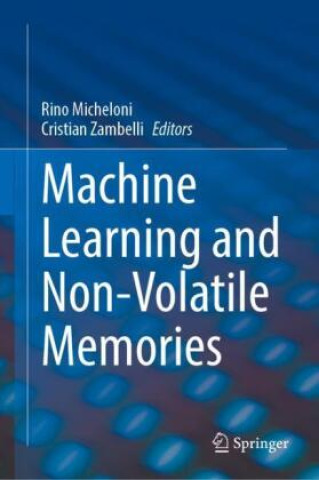
Kniha Machine Learning and Non-volatile Memories Rino Micheloni

Machine Learning and Non-volatile Memories

Jazyk: Angličtina
Vazba: Pevná
Dostupnost: Skladem u dodavatele
Odesíláme za 10-13 dnů
3 426
This book presents the basics of both NAND flash storage and machine learning, detailing the memorie...
Informace o knize

Jazyk
Angličtina
Vazba
Kniha - Pevná
Vydáno
2022
Stránek
161
EAN
9783031038402
Enbook ID
38874468
Hmotnost
453
Rozměry
155 x 235 x 16

Kompletní popis

This book presents the basics of both NAND flash storage and machine learning, detailing the memories problems it can help solve. At a first sight, machine learning and non-volatile memories seem very far away from each other. Machine learning implies mathematics, algorithms and a lot of computation; non-volatile memories are solid-state devices used to store information, having the amazing capability of retaining the information even without power supply. This book will help the reader understand how these two worlds can work together, bringing a lot of value to each other. In particular, the book covers two main fields of application: analog neural networks (NNs) and solid-state drives (SSDs).After reviewing the basics of machine learning in Chapter 1, Chapter 2 shows how neural networks can mimic the human brain; to accomplish this result, neural networks have to perform a specific computation called vector-by-matrix (VbM) multiplication, which is particularly power hungry. In the digital domain, VbM is implemented by means of logic gates which dictate both the area occupation and the power consumption; the combination of the two poses serious challenges to the hardware scalability, thus limiting the size of the neural network itself, especially in terms of the number of processable inputs and outputs. Non-volatile memories (phase change memories in Chapter 3, resistive memories in Chapter 4, and 3D flash memories in Chapter 5 and Chapter 6) enable the analog implementation of the VbM (also called "neuromorphic architecture"), which can easily beat the equivalent digital implementation in terms of both speed and energy consumption.SSDs and flash memories are strictly coupled together; as 3D flash scales, there is a significant amount of work that has to be done in order to optimize the overall performances of SSDs. Machine learning has emerged as a viable solution in many stages of this process. After introducing the main flash reliability issues, Chapter 7 shows both supervised and un-supervised machine learning techniques that can be applied to NAND. In addition, Chapter 7 deals with algorithms and techniques for a pro-active reliability management of SSDs. Last but not least, the last section of Chapter 7 discusses the next challenge for machine learning in the context of the so-called computational storage.No doubt that machine learning and non-volatile memories can help each other, but we are just at the beginning of the journey; this book helps researchers understand the basics of each field by providing real application examples, hopefully, providing a good starting point for the next level of development.
Mohlo by vás zajímat

108

Aristophanes

Aristophanes
416

The Storm Crow

Kalyn Josephson
315
170
600
357
2 286

Zákaznicí kteří koupili tuto knihu koupili také

1 134
88
306
149
89
1 178

Vértices

FRANCISCO ONIEVA
429

Nacimiento de un puente

Maylis de Kerangal
641