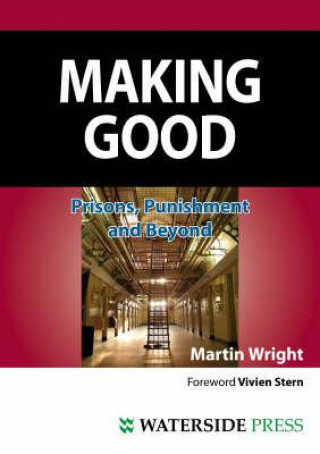
Kniha Making Good Martin Wright

Making Good

Jazyk: Angličtina
Vazba: Brožovaná
Vydavatel: Waterside Press
Dostupnost: Skladem u dodavatele
Odesíláme za 9-15 dnů
770
Second edition with additional material by the author, and a new foreword by one of the UK's leading...

Informace o knize

Jazyk
Angličtina
Vazba
Kniha - Brožovaná
Vydáno
2008
Stránek
320
EAN
9781904380412
ISBN
1904380417
Enbook ID
01362065
Vydavatel
Hmotnost
420
Rozměry
147 x 208 x 18

Kompletní popis

Second edition with additional material by the author, and a new foreword by one of the UK's leading penal reformers. Classic and original - one of the works that paved the way for the development of the Restorative Justice movement. Argues that the real need is for fundamental rethinking of crime and punishment, rather than short-term tinkering with a prison system that is in an intolerable state of crisis. Demonstrates that neither the conservative idea of deterrence through punishment nor the liberal ideal of rehabilitation has worked in practice and proposes the basis for a radical but carefully worked out practical philosophy which would place the emphasis on the offender making amends to the victim and society for the damage caused. 'All those concerned with the monstrosity that is our current prison system, the unchecked growth of the criminal justice system as the response to social problems and the poverty of ideas in dealing with the harm caused by crime will find a re-read of this classic text very worthwhile': Baroness Vivien Stern (from the Foreword). 'The real value of this book is surely in the philosophical arguments that he puts forward to support his thinking. He forces the reader to think through what society's expectations are when someone is sent to prison. Is it to deter against future offending or to deter others? To isolate the criminal from society for the protection of the public? Or is it for rehabilitation? The aims of imprisonment are expounded at length later in the book together with an appraisal of the ethical and practical aspects of punishment, deterrence, denunciation and of justice itself. Making Good provides a demanding, but fascinating read. Although the description of prison life a quarter of a century ago and the thinking behind the policies that determined it, belong to the era in which it was written, the arguments Martin Wright puts forward about justice and punishment still remain pertinent today:' Internet Law Book Reviews. 'Engages with some diverse elements of imprisonment and with contemporary penal issues': Helen Poole, Coventry University. Martin Wright is a former Director of the Howard League for Penal Reform, Policy Officer of Victim Support, and Librarian of the Cambridge Institute of Criminology. He is a Senior Research Fellow, Faculty of Health and Life Sciences, De Montfort University, Leicester, and the author of Restoring Respect for Justice and Justice for Victims and Offenders. He is joint editor of Mediation and Criminal Justice: Victims, Offenders and Community. A founder member of the Restorative Justice Consortium, he is currently a member of its board, and acts as a voluntary mediator in the Lambeth Mediation Service, London. As an active member of the European Forum for Restorative Justice he has spoken at many international conferences, and is an Honorary Fellow of the Institute for Conflict Resolution, Bulgaria.

Mohlo by vás zajímat

329

Sleep in the Military

Wendy M. Troxel
971

Poems of Thomas Bailey Aldrich

Thomas Bailey Aldrich
1 324

General Theory of Employment, Interest and Money

John Maynard (University of Cambridge) Keynes
433
2 306
299

How to Apply the Bible

David R. Veerman
267

Enterprise Security Risk Management

Brian Allen Esq. CISSP CISM CPP CFE
2 167

Black Boy

Richard Wright
332

Free Ride

Noraly Schoenmaker
271
356
695

From Prague After Munich

George Frost Kennan
2 478
740

Building Adaptation

James Douglas
2 292
1 576

Zákaznicí kteří koupili tuto knihu koupili také

Agathe

Ducange-V
326
455

Emoční inteligence

Daniel Goleman
312
584
253

Tarot skrytých světů

Stephanie Pui-Mun Law
565