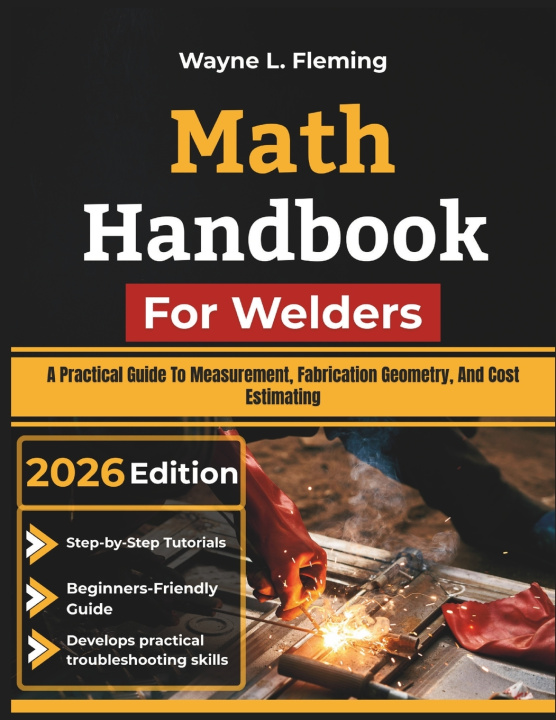
Math Handbook for Welders
- Does welding math feel overwhelming the moment you start dealing with fractions, decimals, unit conversions, angles, weld volumes, and material estimates?
- Have you ever wondered how shop arithmetic, blueprint dimensions, geometry, the Pythagorean theorem, trigonometry, pipe offsets, weld strength, heat input, and cost estimating all come together into one set of skills that actually turns a drawing into a finished, profitable weldment?
- Are you looking for a clear, practical, and professional guide that teaches welding math the way it is actually used, measured, calculated, and applied in real shops, on real job sites, and in everyday field work?
Math Handbook for Welders is your complete, hands-on guide to understanding, calculating, laying out, estimating, and verifying the math behind every weld, from the first measurement to the final invoice. Whether you are a beginner entering the welding trade, an apprentice building confidence, a journeyman sharpening your layout and estimating skills, a fabricator reviewing job costs, a welding student learning the fundamentals, or a serious DIY reader seeking real working knowledge, this handbook gives you the structured, real-world instruction you need, in both U.S. customary and metric (SI) units, woven through every chapter the way modern AWS dual-unit codes now demand.
Inside This Handbook, You Will Learn How to:
- Master shop arithmetic, fractions, and decimals the way they actually appear on a tape measure, a caliper, and a cut list, with the estimating habits that catch your mistakes before they reach the metal
- Read precision tools and tolerances, and know exactly how exact you need to be, so you never waste effort or scrap a part to false precision
- Convert length, area, volume, weight, force, pressure, and temperature between inches and millimeters, pounds and kilograms, Fahrenheit and Celsius, without the squaring-and-cubing errors that wreck area and volume conversions
- Read and interpret blueprints, decode welding symbols and what their numbers mean, and calculate the dimensions a drawing implies but never states
- Use geometry, the Pythagorean theorem, and trigonometry to square frames, lay out angles, find brace lengths, and handle the slopes, bevels, and compound angles that stop less-numerate welders cold
- Apply the 3-4-5 method and the diagonal check to lay out perfect square corners with nothing but a tape measure
- Calculate weld metal volume, deposition efficiency, and exactly how much filler and shielding gas to buy, so you stop guessing and stop wasting money
- Lay out pipe offsets, rolling offsets, miters, and lateral connections, then wrap and mark the pipe for accurate cuts, the specialized skill that sets pipe fitters apart
- Control heat, expansion, distortion, and cooling rates so your welds hold instead of cracking or pulling out of square
- Estimate material weights, weld costs, labor, overhead, and markup versus margin, so the beautiful weld you just made actually turns a profit
- Solve real shop scenarios with worked, step-by-step examples and practice problems in every chapter, drawn from the situations you actually face at the bench
More Than a Textbook, A Practical Field Companion
Math Handbook for Welders is not just a book for reading through formulas and code language. It is a working guide for building real understanding.
If you are ready to understand welding math with clarity, confidence, and practical professional depth, this book is your essential guide. Scroll up and get your copy today, and start mastering welding math the clear, practical, and professional way.