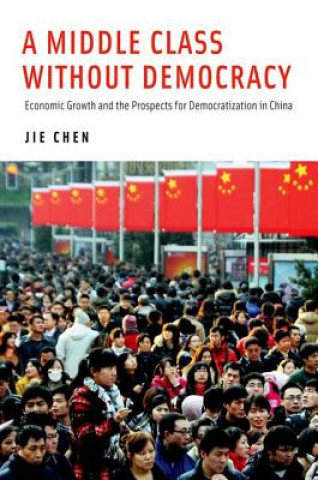
Kniha Middle Class Without Democracy Jie Chen

Middle Class Without Democracy

Economic Growth and the Prospects for Democratization in China

Autor: Jie Chen
Jazyk: Angličtina
Vazba: Pevná
Dostupnost: Skladem u dodavatele
Odesíláme za 10-18 dnů
1 609
What kind of role can the middle class play in potential democratization in such an undemocratic, la...


Informace o knize

Autor
Jazyk
Angličtina
Vazba
Kniha - Pevná
Vydáno
2013
Stránek
240
EAN
9780199841639
ISBN
0199841632
Enbook ID
04536279
Hmotnost
448
Rozměry
166 x 240 x 21

Kompletní popis

What kind of role can the middle class play in potential democratization in such an undemocratic, late developing country as China? To answer this profound political as well as theoretical question, Jie Chen explores attitudinal and behavioral orientation of China's new middle class to democracy and democratization. Chen's work is based on a unique set of data collected from a probability-sample survey and in-depth interviews of residents in three major Chinese cities, Beijing, Chengdu and Xi'an-each of which represents a distinct level of economic development in urban China-in 2007 and 2008. The empirical findings derived from this data set confirm that (1) compared to other social classes, particularly lower classes, the new Chinese middle class-especially those employed in the state apparatus-tends to be more supportive of the current Party-state but less supportive of democratic values and institutions; (2) the new middle class's attitudes toward democracy may be accounted for by this class's close ideational and institutional ties with the state, and its perceived socioeconomic wellbeing, among other factors; (3) the lack of support for democracy among the middle class tends to cause this social class to act in favor of the current state but in opposition to democratic changes. The most important political implication is that while China's middle class is not likely to serve as the harbinger of democracy now, its current attitudes toward democracy may change in the future. Such a crucial shift in the middle class's orientation toward democracy can take place, especially when its dependence on the Party-state decreases and perception of its own social and economic statuses turns pessimistic. The key theoretical implication from the findings suggests that the attitudinal and behavioral orientations of the middle class-as a whole and as a part-toward democratic change in late developing countries are contingent upon its relationship with the incumbent state and its perceived social/economic wellbeing, and the middle class's support for democracy in these countries is far from inevitable.

Mohlo by vás zajímat

Eel Question

Nicola Davies
214
532
593
331
509

Ulster

Stephen Lucius Gwynn
664
347

Get Tough!

W. E. Fairbairn
331

Museum Worlds

SANDRA DUDLEY
4 176

Leveraged Buyouts

David Pilger
946

Dangerous Women Part 2

George Raymond Richard Martin
246

Gaia Oracle

Toni Carmine Salerno
476

Zákaznicí kteří koupili tuto knihu koupili také

215
1 255
538
488

DUNE

LYNCH/ANNIS
447

Miguel Delibes

RAMON GARCIA DOMINGUEZ
369
259