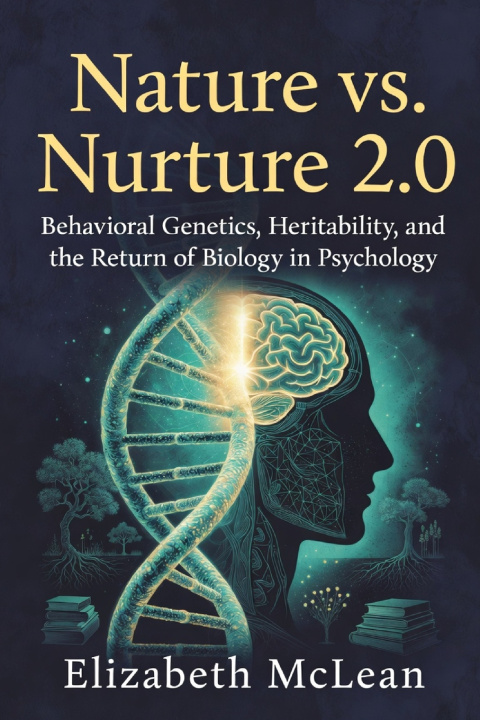
Nature vs. Nurture 2.0 delivers a comprehensive and intellectually honest examination of the return of biology to psychology. Building on the historical critique of blank slate thinking in the author's earlier work, this volume synthesizes decades of twin, adoption, and family studies with the molecular revolution of GWAS and polygenic scores.
The book explains core concepts such as heritability, gene-environment correlation and interaction, epigenetics, and the Wilson effect with clarity and precision. It addresses persistent controversies-including the genetic fallacy, within- versus between-group differences, and ethical concerns-while offering constructive frameworks for responsible application in education, mental health, criminal justice, and public policy.
Written as an advanced textbook, it includes extensive pedagogical features: learning objectives, case studies, research spotlights, discussion questions, and interdisciplinary connections. The central message is one of hopeful realism: genetic influences are substantial and systematic, yet human development remains profoundly shaped by experience, context, and agency. This is not a return to determinism, but a more accurate, compassionate, and effective foundation for psychology and social policy.
This volume serves as both a standalone textbook and a natural companion to the author's Tabula Rasa series and her book on evolutionary psychology.