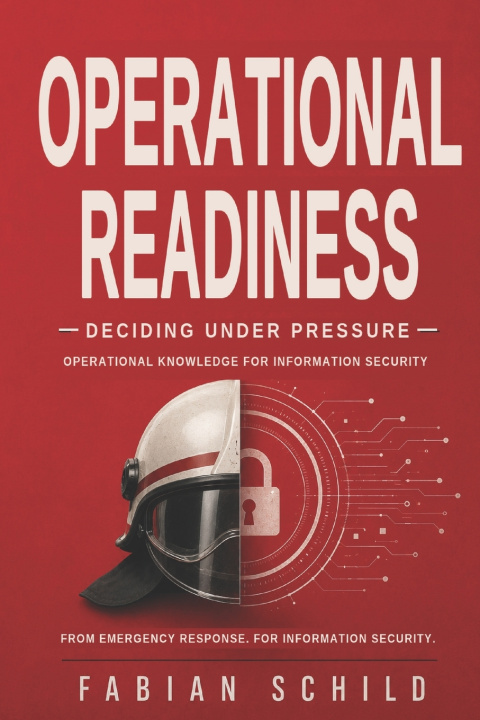
What the fire service has long known, and information security could put to use
Information security is rich in standards, frameworks, and controls. What it lacks are reliable answers for the moment when the controls have already failed: decisions made under time pressure, with incomplete information, and with real consequences. It is precisely for this moment that the emergency services have developed patterns over generations, patterns that were not born at a desk but where mistakes become visible at once.
For years, Fabian Schild led a double life: active in one of Germany's largest volunteer fire brigades and, at the same time, a specialist in cyber defence, security strategy, and risk management. In Operational Readiness he makes that act of translation visible and shows that the fire service and information security are, at their core, working on the same question: how does an organization respond to an emergency when something goes wrong that no one fully foresaw?
In this book you will learn, among other things:
- How the fire service's situation assessment lets you reach a reliable evaluation quickly, even when the information is contradictory
- Hhy "assume breach" is not a modern invention but a 150-year-old stance, and what that means for your security architecture
- How a genuine error culture arises, not as an HR program but as an operational necessity
- Why most exercises fail in a real emergency, and how to build exercise realism to fire-service standard
- How fragmented dashboards become a shared operational picture when a crisis hits
- Every chapter opens with a scene from a real operation, draws the parallel to information security, and closes with a concrete tool for your practice.
Who this book is for: security leaders, information security officers, business continuity and emergency managers, and IT and risk leaders in mid-sized and large organizations. All fire-service terminology is explained; a working knowledge of information security is assumed.
A note for the international reader: the book draws on the author's experience in the German fire service. Where German institutions, ranks, or regulations appear, they are briefly explained. The principles they embody, however, are universal, and readers will recognize their counterparts in the incident command systems of their own countries.
Operational Readiness does not idealize the fire service, and it does not devalue information security. It takes both disciplines seriously enough to let them learn from each other, and it gives those who carry responsibility the tools they need to lead successfully through the emergencies still to come.