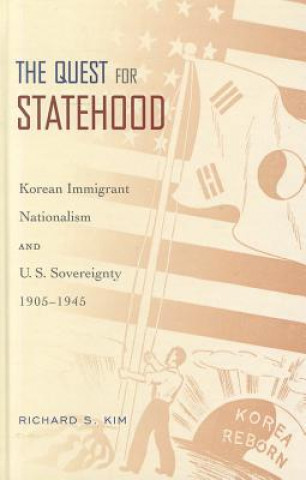
Kniha Quest for Statehood Richard S. Kim

Quest for Statehood

Korean Immigrant Nationalism and U.S. Sovereignty, 1905-1945

Jazyk: Angličtina
Vazba: Pevná
Dostupnost: U nakladatele na objednávku
Odesíláme za 28-34 dnů
1 983
Korean diasporic nationalism in the years between 1905 and 1945 played a foundational role in the em...


Informace o knize

Jazyk
Angličtina
Vazba
Kniha - Pevná
Vydáno
2011
Stránek
240
EAN
9780195369991
ISBN
0195369998
Enbook ID
04518458
Hmotnost
436
Rozměry
162 x 236 x 21

Kompletní popis

Korean diasporic nationalism in the years between 1905 and 1945 played a foundational role in the emergence of the two separate Koreas after 1945 that both exist to this day. Koreans in the United States were a constitutive part of this historical trajectory. The Quest for Statehood traces the development of Korean immigrant nationalism within the context of the Korean independence movement which sought to liberate Korea from Japanese colonization. Regarding Japanese rule as illegitimate, Koreans in and out of the Korean peninsula viewed themselves as stateless peoples who wanted to establish a sovereign state of their own. Given Japanese repression in Korea, independence activities had to be carried out from abroad, creating conditions for the emergence of a diasporic nationalism. Situated at the nexus of geopolitical relations involving Korea, Japan, and the United States, Koreans in America came to play a vital role in the state-building project of Korean diasporic nationalism. The Quest for Statehood explores the consequences and implications of Korean diasporic identifications with the homeland in a U.S. setting. Due to the constraints of diasporic state-building, U.S.-based Koreans increasingly came to rely on the power of the United States to act as a sovereign state to pursue the national interests of Koreans throughout the diaspora. This study contends this strategic reliance on U.S. state power reflected the development of an ethnic consciousness among Korean immigrants in America. The efforts of Korean immigrants to fight for the independence of their homeland necessitated their participation in civic and political activities in the United States that established them as an American ethnic group. Korean nationalism thus paradoxically led to Korean immigrant incorporation into American political structures whereby ethnicity served as an organizational resource for making nationalist claims in the U.S. political arena. Ultimately, homeland nationalism was central to the assimilation of Korean immigrants as American ethnics.

Mohlo by vás zajímat

Olga Dies Dreaming

XOCHITL GONZALEZ
237
230
185

Pesahim

Adin Even-Israel Steinsaltz
808

Fourth Socio-Educational Transformation in Mexico

Limon Dominguez Gerardo Arturo Limon Dominguez
1 513

Tundras

Samantha Nugent
621

Comic Toolbox

John Vorhaus
266

Winner Effect

Ian Robertson
283

Self-Organizing Systems

Christian Bettstetter
1 310

House Of Lies

Martin Kihn
390
3 782

Men and Women Adrift

Margaret Spratt
2 760

America from the Air

Wolfgang Langewiesche
838

Poetry

Richard Bradford
3 566
113

Zákaznicí kteří koupili tuto knihu koupili také

Školní detektiv

Zuzana Pospíšilová
213

Cele 7 Peceti

Ovidiu Dragos Argesanu
142
445