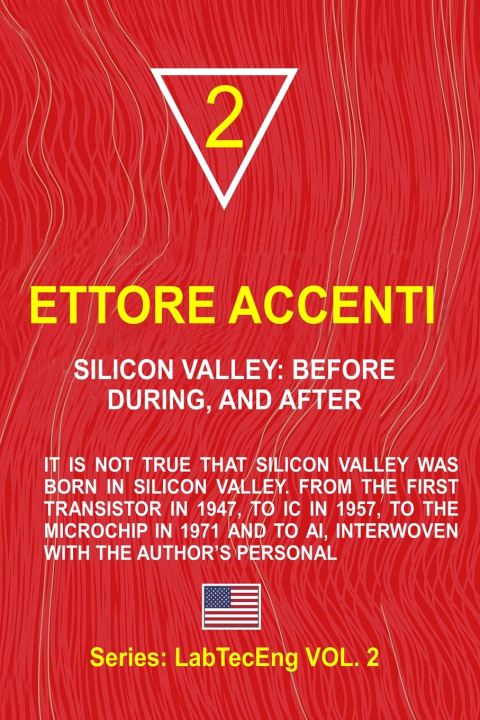
It Is Not True That Silicon Valley Was Born in Silicon Valley is a lucid, passionate, and deeply human account of the birth of the contemporary technological world, seen from the inside through the eyes of one of its direct witnesses.
From the invention of the transistor in 1947 to the birth of the microprocessor; from integrated circuits to Moore's Law; from the space race to the global spread of computers and smartphones, and all the way to artificial intelligence, this book retraces the fundamental milestones that transformed a small crystal of germanium, and later silicon, into the invisible engine of digital civilization. It does so in a distinctive way: not as a cold sequence of dates and patents, but as a lived story, woven from personal encounters, travels, anecdotes, and reflections shaped by more than half a century of direct experience.
The author leads the reader into the laboratories, factories, and streets of what would become Silicon Valley when it was not yet called by that name, offering an insider's account of the birth of legendary companies and the decisive role played by figures such as William Shockley, Robert Noyce, Gordon Moore, Federico Faggin, Steve Jobs, and many others, known and frequented not only professionally but also on a personal and family level, accompanied by authentic images, many of them previously unpublished. What emerges is an authentic portrait of an unrepeatable era, marked by enthusiasm, risk, failures, and visions that changed the world.
Alongside the historical and autobiographical narrative, the book addresses highly topical issues: the relationship between complexity and intelligence, the limits of artificial intelligence, the difference between computation and consciousness, and the possible future consequences of technological evolution. Moore's Law thus becomes not merely an industrial forecast, but a key to understanding the past and questioning the future of humanity in a world increasingly dominated by microchips.
A book that is at once personal memoir, history of technology, and cultural reflection, suited to engineers, innovation enthusiasts, students, entrepreneurs, and anyone who wants to understand how we arrived here-and why the heart of the digital revolution began beating much earlier, and much farther away, than is commonly believed.