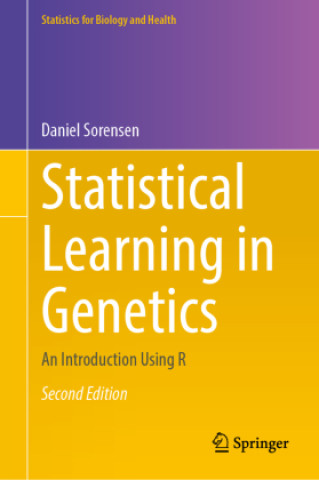
Kniha Statistical Learning in Genetics Daniel Sorensen

Statistical Learning in Genetics

An Introduction Using R

Jazyk: Angličtina
Vazba: Pevná
Vydavatel: Springer, Berlin
Dostupnost: Skladem u dodavatele
Odesíláme za 10-13 dnů
3 882
This book provides an introduction to computer-based methods for the analysis of genomic data. Break...


Informace o knize

Jazyk
Angličtina
Vazba
Kniha - Pevná
Vydáno
2025
Stránek
584
EAN
9783031862731
Enbook ID
47701800
Vydavatel
Hmotnost
1255
Rozměry
155 x 235

Kompletní popis

This book provides an introduction to computer-based methods for the analysis of genomic data. Breakthroughs in molecular and computational biology have contributed to the emergence of vast data sets, where millions of genetic markers for each individual are coupled with medical records, generating an unparalleled resource for linking human genetic variation to human biology and disease. Similar developments have taken place in animal and plant breeding, where genetic marker information is combined with production traits. An important task for the statistical geneticist is to adapt, construct and implement models that can extract information from these large-scale data. An initial step is to understand the methodology that underlies the probability models and to learn the modern computer-intensive methods required for fitting these models. The objective of this book, suitable for readers who wish to develop analytic skills to perform genomic research, is to provide guidance to take this first step.

This book is addressed to numerate biologists who may lack the formal mathematical background of the professional statistician. For this reason, considerably more detailed explanations and derivations are offered. Examples are used profusely and a large proportion involves programming with the open-source package R. The code needed to solve the exercises is provided and it can be downloaded, allowing students to experiment by running the programs on their own computer.

Part I presents methods of inference and computation that are appropriate for likelihood and Bayesian models. Part II discusses prediction for continuous and binary data using both frequentist and Bayesian approaches. Some of the models used for prediction are also used for gene discovery. The challenge is to find promising genes without incurring a large proportion of false positive results. Therefore, Part II includes a detour on the False Discovery Rate, assuming frequentist and Bayesian perspectives. The last chapter of Part II provides an overview of a selected number of non-parametric methods. Part III consists of exercises and their solutions. This second edition has benefited from many clarifications and extensions of themes discussed in the first edition.

Daniel Sorensen

Mohlo by vás zajímat

Kaiju No. 8, Vol. 4

Naoya Matsumoto
214

MOON ABOVE THE FRONTLINE

Alimohammad Afghani
348

Pearl

John Steinbeck
188
370

Inward

Yung Pueblo
268
443
781
237

Cycles of Violence

Ranan D Kuperman
1 537

Fast Five

Donna Hay
576

Uprooted

Volha Charnysh
832

Zákaznicí kteří koupili tuto knihu koupili také

Blue lock

Muneyuki Kaneshiro
235

Armas para que?

Antônio Rangel Bandeira
747

Mandel

Sebastian Bring
447
928
540
308
289

Amelia

Cristina Bellemo
381

JIGOKURAKU 04

KAKU YUJI
231

Tsunami

Ivan Vičar
243

Tokyo Ghoul

Sui Ishida
178
295