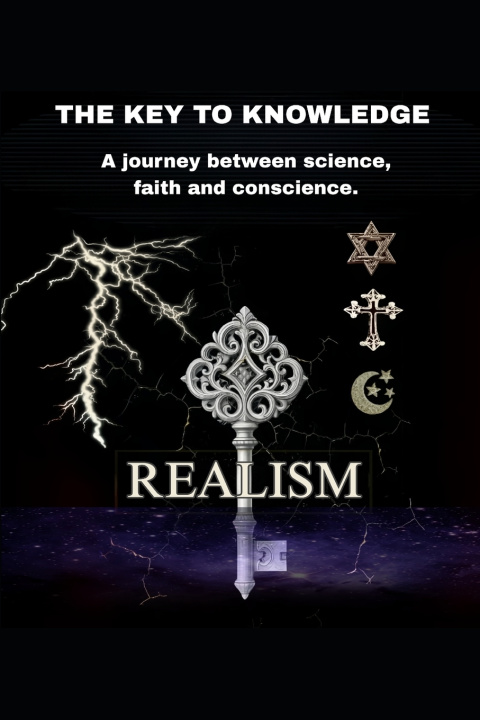
"Beyond - The Key to Knowledge"
Where do we come from? Who are we? Where do our faiths originate?
Beyond - The Key to Knowledge is an unprecedented journey that begins from the very instant of the Big Bang and travels through 13.8 billion years of cosmic, biological, and human history, all the way to the critical analysis of the Scriptures and religious institutions. A work of narrative non‑fiction that does not ask you to abandon your faith, but to look with new eyes at the roots of the traditions that have shaped Western civilization.
From stardust to the first cell
With the rigor of scientific popularization and the lightness of a fable, the author recounts the birth of the universe, the formation of Earth, the emergence of life from prebiotic chemistry, the evolutionary alliance of mitochondria, and the Cambrian explosion. Each chapter is a piece of the mosaic showing how matter, over billions of years, learned to organize itself, to think, and to question its own meaning.
From the first hominids to the cathedrals
Humans standing upright, fire, the first burials with flowers, the shaman and the drum: the book accompanies the reader to discover the origins of symbolic and religious thought. From Göbekli Tepe, the first temple built by hunter‑gatherers, to the great gods of the Nile, Tigris and Euphrates rivers, to the birth of writing and the formation of sacred texts.
The Bible, the Gospels, and the Councils: a critical and respectful gaze
Applying the tools of historical criticism (earliest source, multiple attestation, criterion of embarrassment, coherence, dissimilarity), the author examines the non‑historicity of Abraham and Moses, the stratification of the Torah, the chronological contradictions of the Gospels (Herod vs. Quirinius), the apocalyptic expectation that did not come to pass, and Paul's role in the invention of original sin. The councils that defined the Trinity - with non‑biblical words imposed by emperors - and the female figures of the Scriptures, from Eve to Mary Magdalene, are also analyzed.
Ethics, secularism, and freedom of thought
The final part of the book addresses the great issues of civil coexistence: ethics without commandments (based on empathy and mirror neurons), secularism as a guarantee of mutual respect, and the construction of a society in which believers and non‑believers can inhabit the same space without overpowering each other.
Who this book is for
For those seeking an honest and well‑documented dialogue with their own religious tradition. For those who want to understand where the sacred texts come from, how they were formed, and why they contain contradictions. For those who love science, history, and critical thinking, without renouncing wonder. The author does not deny anyone's faith: he offers tools. Every reader is free to draw their own conclusions.
A journey that continues
This is the first volume of a series. The second will address the Qur'an and Islam, the third the great Eastern traditions. Beyond is written by an independent author, not affiliated with any religious organization. The opinions expressed are solely the fruit of observation, source comparison, and critical thinking.
"There is no absolute truth you have learned. There is a journey you have taken. You started from the singularity and arrived at the candle lit before a statue. You have not found definitive answers. You have found tools to dig, and the freedom to choose what to seek."