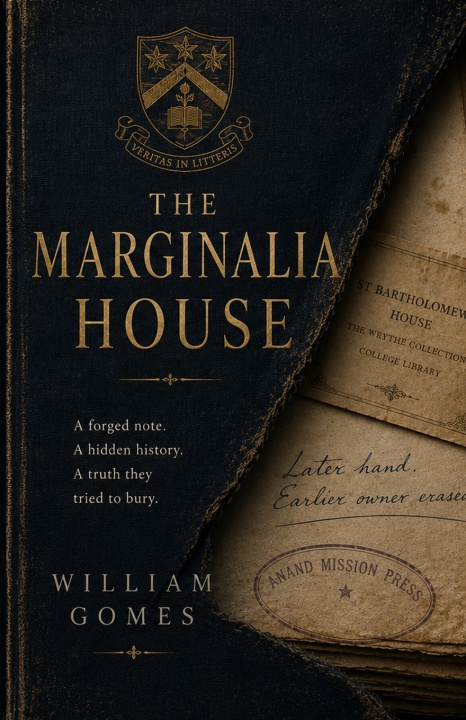
At St Bartholomew's House, old books are not only preserved. They are arranged, displayed, inherited, and made to tell the stories powerful people need them to tell.
Leila Rahman, a careful and exacting provenance librarian, has spent her career correcting the record quietly. When she is asked to prepare a valuable volume from the Wrythe Collection for a public celebration, she notices something almost invisible in the margin: a celebrated handwritten annotation does not sit properly on the page. The pencil mark that the college calls a scholar's "living conversation" with the text may have been added much later than anyone is willing to admit.
What begins as a technical doubt becomes something larger and more dangerous. A lifted bookplate. An erased ownership mark. A restricted file. A missing set of images. A dead donor found beside the book on a storm-sealed night. As Leila follows the evidence through catalogues, ledgers, locked cabinets, and institutional silences, she uncovers a hidden provenance connected to the Anand Mission Press, and a history the college has spent generations making respectable.
But truth inside an institution has a cost. To expose the forged marginalia is one thing. To prove what happened to the man who died beside it is another.
The Marginalia House is a literary mystery about archives, power, erased ownership, colonial inheritance, scholarly ambition, and the difference between correcting a record and telling the truth. Atmospheric, intelligent, and morally charged, it follows one woman's refusal to let a lie remain safely in the margin.
For readers drawn to literary fiction, archival mysteries, campus novels, and stories about institutions, memory, and justice, The Marginalia House is a slow-burning novel of paper, silence, and consequence.
Read The Marginalia House and enter a world where the smallest mark in a margin can bring an entire institution into question.