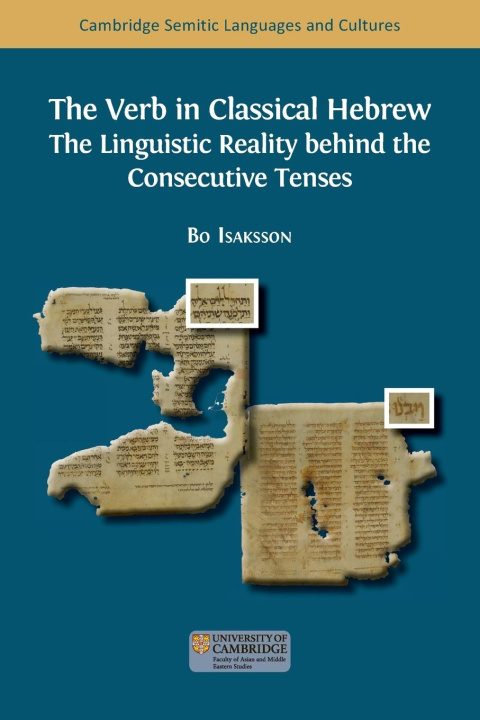
Kniha The Verb in Classical Hebrew Bo Isaksson

The Verb in Classical Hebrew

Autor: Bo Isaksson
Jazyk: Angličtina
Vazba: Brožovaná
Dostupnost: Skladem u dodavatele
Odesíláme za 14-21 dnů
939
The consecutive tenses are fundamental in all descriptions of Classical Hebrew grammar. They are eve...
Informace o knize

Autor
Jazyk
Angličtina
Vazba
Kniha - Brožovaná
Vydáno
2024
Stránek
752
EAN
9781805113508
ISBN
180511350X
Enbook ID
46548095
Hmotnost
1121
Rozměry
156 x 234 x 41

Kompletní popis

The consecutive tenses are fundamental in all descriptions of Classical Hebrew grammar. They are even basic to the textbooks on Biblical Hebrew. Being fundamental in the verbal system, and part of any beginner's grammar, they pose a serious problem to a linguistic understanding of the verbal system, since grammars describe an alternation of 'forms' or 'tenses' in double pairs: wayyiqṭol alternates with its 'equivalent' qaṭal, and wə-qaṭal alternates with its 'equivalent' yiqṭol.
This 'enigma' in the verbal system is handled in the book by recognising that the alternation of the consecutive tenses with other tenses, in the reality of the text, represents a linking of clauses. The 'consecutive tenses' are clause-types with a natural language connective wa- directly followed by a finite verbal morpheme, a type of clause that expressed continuity in the earliest stage of Semitic. The commonly held assumption that there is a special 'consecutive waw' is unwarranted. The use of the 'consecutive' clause-types in order to express discourse continuity indicates that Classical Hebrew has retained the old unmarked declarative word order of Semitic syntax. Seen in the light of recent research on the Tiberian reading tradition, the 'consecutive' wayyiqṭol can be analysed as a retention of the old Semitic past perfective *wa-yaqtul, which was pronounced wa-yiqṭol in Classical Hebrew. The 'consecutive' wə-qāṭal (pronounced wa-qaṭal in the classical language) constitutes the result of an internal Hebrew development into a construction (in the sense of Joan Bybee) already foreshadowed in the earliest Northwest Semitic languages.

The book understands the 'consecutive tenses' as discourse continuity clauses, which typically form chains of main line clauses. Such chains can be interrupted by other types of clauses. This interruption is a clause linking that receives special attention in the interpretation of the Classical Hebrew verbal system. Chapter six presents a regenerated text linguistics founded on the new terminology. A clause linking approach is the central methodological procedure in this book. To this must be added diachronic typology in a comparative Semitic setting. The linguistic examples of clause linking are gathered from a large Classical Hebrew corpus, the Pentateuch and the Book of Judges, and made searchable in a database of 6559 non-archaic text records.

Mohlo by vás zajímat

1 535

AZ URANTIA KONYV KIAD/E

Urantia Foundation
477
3 181
422
1 003

Murder in Rat Alley

Mark de Castrique
527

Team Topologies

Matthew Skelton
487
523
186
589

Night Hag

Hester Musson
294

Istanbul

WARREN ÍZLEM
626

Invisible Ink

Brian McDonald
482

Zákaznicí kteří koupili tuto knihu koupili také

Character of Consciousness

David J D J Chalmers
923
447
1 180

Organische Chemie

Eberhard Breitmaier
1 636

Specjalne potrzeby edukacyjne

Agnieszka Olechowska
513

Ejercicios de cálculo IV

Enrique Izquierdo Guallar
595

Pecalovina

Miroslav B Mladenovic Mirac
230
520
388

Lapvona

Anke Caroline Burger
483
752