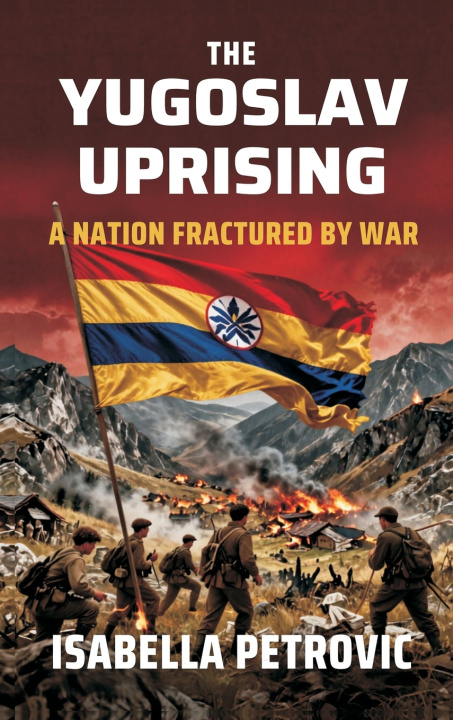
In April 1941, the Kingdom of Yugoslavia collapsed in eleven days under coordinated Axis invasion. What followed was not a four-year occupation followed by liberation, but something far more complex: a simultaneous war of occupation, civil war among rival resistance movements, and a series of ethnic conflicts that occupiers actively cultivated. By the time the guns fell silent in 1945, more than a million people had died, the great majority at the hands of fellow Yugoslavs. The Yugoslav Uprising: A Nation Fractured by War reconstructs this layered conflict with analytical clarity, treating it not as a moral pageant but as a structural case study in how states fracture and how new authority emerges from the ruins.
Isabella Petrovic traces the full arc, from the strained interwar kingdom to the consolidation of federal Yugoslavia under communist rule. She examines the Ustasha regime in Croatia and its genocidal programme, the royalist Chetnik movement and its strategic paralysis, and the rise of the Partisans under Tito, who alone built a movement capable of operating across ethnic lines. Particular attention is paid to axis occupation practices and the strategies of divide and rule that exploited pre-existing cleavages, often with devastating effect. The book also examines ethnic violence beyond the most familiar episodes, including Chetnik operations against Muslims, Albanian-Serb conflict in Kosovo, and Hungarian violence in Vojvodina, showing how multiple atrocity campaigns interacted within a single war.
Written for general readers, students of twentieth-century history, and analysts of insurgency and post-conflict politics, the book offers a framework for understanding multi-sided conflict that extends well beyond the Balkans. Readers will come away with a clearer sense of how occupation regimes function, why resistance movements splinter, and how civil war dynamics operate beneath the surface of nominally external wars. The Yugoslav case is among the richest in modern history for thinking about these questions, and Petrovic treats it with the seriousness it deserves. The result is neither a national epic nor a counter-narrative of grievance, but a structural account of one of the twentieth century's most consequential and least understood conflicts.