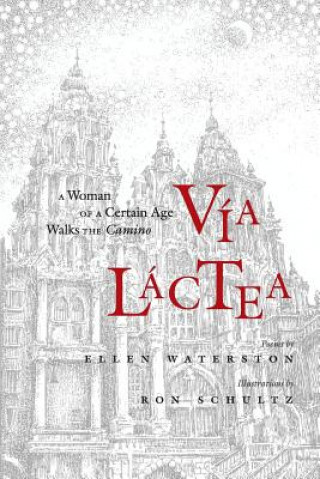
Following in the footsteps of thousands of pilgrims, penitents, and seekers over centuries, in 2012 Ellen Waterston walked the sacred ground of Spain's Camino de Santiago in search of answers to "What's next?" questions, a quest prompted by stepping down after 11 years as founder/director of a literary arts nonprofit. The list of life questions Waterston was certain she would resolve was quickly supplanted by what the Camino had in mind. Upon her return to Oregon, sorting through mementos of the trip, she was struck by a map of the ten Camino routes that converge in Santiago. The image of a woman leaping rose from the map and Camino Woman was born. This fictional character is the embodiment of all holy women marginalized by patriarchal religions, and spawned other characters, including a fictionalized peregrina of a certain age," a stylized and profane Catholic church in Father Tomas, an omniscient third-person voice, the role of the hospitalero as wisdom keeper, and caricatures of others met along the way. The title of the book has its origins in the fact that the Camino is often referred to as the Via Lactea, a reference to the fact that the Milky Way is always overhead when walking the Camino. Via Lactea is a verse novel, with a storyline that threads through it. It includes many styles and forms of poetry including free verse, new forms, and traditional ones-such as the haibun, described as terse prose usually ending with a haiku. The haibun is often associated with travel writings. Another form, the tanka, is sometimes referred to as "short song." Its meter and shape on the page both mimicked the robotic action, day after day, of walk, eat, sleep, walk some more, and the isolation Waterston sometimes felt on the trail. Another form, the ghazal, is built of couplets and repetitions. For Waterston, its form mirrored the constant rain, day after day, while on the Camino.